

An Open Letter to India’s Graduating Classes
 |
|
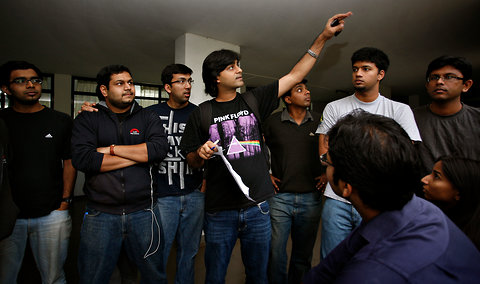
Namas Bhojani for The New York Times Students prepare for summer placements at the Indian Institute of Management (IIM), Bangalore, in this November 10, 2008 file photo. |
Dear Graduates and Post-Graduates,
This is your new employer. We are an Indian company, a bank, a consulting firm, a multinational corporation, a public sector utility and everything in between. We are the givers of your paycheck, of the brand name you covet, of the references you will rely on for years to come and of the training that will shape your professional path.
Millions of you have recently graduated or will graduate over the next few weeks. Many of you are probably feeling quite proud – you’ve landed your first job, discussions around salaries and job titles are over, and you’re ready to contribute.
Life is good – except that it’s not. Not for us, your employers, at least. Most of your contributions will be substandard and lack ambition, frustrating and of limited productivity. We are gearing ourselves up for broken promises and unmet expectations. Sorry to be the messenger of bad news.
Today, we regret to inform you that you are spoiled. You are spoiled by the “India growth story”; by an illusion that the Indian education system is capable of producing the talent that we, your companies, most crave; by the imbalance of demand and supply for real talent; by the deceleration of economic growth in the mature West; and by the law of large numbers in India, which creates pockets of highly skilled people who are justly feted but ultimately make up less than 10 percent of all of you.
So why this letter, and why should you read on? Well, because based on collective experience of hiring and developing young people like you over the years, some truths have become apparent. This is a guide for you and the 15- to 20-year-olds following in your footsteps – the next productive generation of our country. Read on to understand what your employers really want and how your ability to match these wants can enrich you professionally.
There are five key attributes employers typically seek and, in fact, will value more and more in the future. Unfortunately, these are often lacking in you and your colleagues.
1.You speak and write English fluently: We know this is rarely the case. Even graduates from better-known institutions can be hard to understand.
Exhibit No. 1: Below is an actual excerpt from a résumé we received from a “highly qualified and educated” person. This is the applicant’s “objective statement:”
“To be a part of an organization wherein I could cherish my erudite dexterity to learn the nitigrities of consulting”
Huh? Anyone know what that means? We certainly don’t.
And in spoken English, the outcomes are no better. Whether it is a strong mother tongue influence, or a belief (mistakenly) that the faster one speaks the more mastery one has, there is much room for improvement. Well over half of the pre-screened résumés lack the English ability to effectively communicate in business.
So the onus, dear reader, is on you – to develop comprehensive English skills, both written and oral.
2. You are good at problem solving, thinking outside the box, seeking new ways of doing things: Hard to find. Too often, there is a tendency to simply wait for detailed instructions and then execute the tasks – not come up with creative suggestions or alternatives.
Exhibit No. 2: I was speaking with a colleague of mine who is a chartered accountant from Britain and a senior professional. I asked him why the pass percentage in the Indian chartered accountant exam was so low and why it was perceived as such a difficult exam.
Interestingly (and he hires dozens of Indian chartered accountants each year), his take is as follows: the Indian exam is no harder than the British exam. Both focus on the application of concepts, but since the Indian education system is so rote-memorization oriented, Indian students have a much more difficult time passing it than their British counterparts.
Problem-solving abilities, which are rarely taught in our schooling system, are understandably weak among India’s graduates, even though India is the home of the famous “jugadu,” the inveterate problem solver who uses what’s on hand to find a solution. Let’s translate this intrinsic ability to the workforce.
3. You ask questions, engage deeply and question hierarchy: How we wish!
Exhibit No. 3: Consistently, managers say that newly graduated hires are too passive, that they are order-takers and that they are too hesitant to ask questions. “Why can’t they pick up the phone and call when they do not understand something?” is a commonly asked question.
You are also unduly impressed by titles and perceived hierarchy. While there is a strong cultural bias of deference and subservience to titles in India, it is as much your responsibility as it is ours to challenge this view.
4. You take responsibility for your career and for your learning and invest in new skills: Many of you feel that once you have got the requisite degree, you can go into cruise control. The desire to learn new tools and techniques and new sector knowledge disappears. And we are talking about you 25- to 30-year-olds – typically the age when inquisitiveness and hunger for knowledge in the workplace is at its peak.
Exhibit No. 4: Recently, our new hires were clamoring for training. Much effort went into creating a learning path, outlining specific courses (online, self-study) for each team. With much fanfare, an e-mail was sent to the entire team outlining the courses.
How many took the trainings? Less than 15 percent. How many actually read the e-mail? Less than 20 percent.
The desire to be spoon-fed, to be directed down a straight and narrow path with each career step neatly laid out, is leading you toward extinction, just like the dinosaurs. Your career starts and ends with you. Our role, as your employer, is to ensure you have the tools, resources and opportunities you need to be successful. The rest is up to you.
5. You are professional and ethical: Everyone loves to be considered a professional. But when you exhibit behavior like job hopping every year, demanding double-digit pay increases for no increase in ability, accepting job offers and not appearing on the first day, taking one company’s offer letter to shop around to another company for more money — well, don’t expect to be treated like a professional.
Similarly, stretching yourself to work longer hours when needed, feeling vested in the success of your employer, being ethical about expense claims and leaves and vacation time are all part of being a consummate professional. Such behavior is not ingrained in new graduates, we have found, and has to be developed.
So what can we conclude, young graduates?
My message is a call to action: Be aware of these five attributes, don’t expect the gravy train to run forever, and don’t assume your education will take care of you. Rather, invest in yourself – in language skills, in thirst for knowledge, in true professionalism and, finally, in thinking creatively and non-hierarchically. This will hold you in good stead in our knowledge economy and help lay a strong foundation for the next productive generation that follows you.
Together, I hope we, your employer, and you, the employee, can forge an enduring partnership.
The author is a partner with KPMG, and these are his personal views.
(The New York Times)

![[Cẩm nang Tân sinh viên #3] Những “tọa độ” HSU tân sinh viên cần lưu lại](https://www.hoasen.edu.vn/wp-content/uploads/2026/09/cam-nang-tan-sinh-vien-toa-do-hsu.jpg)